
Updated: September, 2026
If you’re searching for what to do with a house after a parent dies, how to sell an inherited home, or simply wondering what to do with the house after a major life change, you’re not alone.
The hardest part of where you find yourself right now isn’t just the house itself.
It’s everything happening around it.
As legal responsibilities, financial realities, family dynamics, and care decisions begin to collide, the weight of the situation grows. Often, the pressure to make a decision about the house arrives long before there is enough clarity to make one with confidence.
If you’re reading this, there’s a good chance you’re in the middle of a situation that never came with instructions.
Maybe your mom fell unexpectedly, and what started as a hospital stay has become conversations about assisted living. Now you’re wondering whether she’ll ever return home—and what that means for the house.
Maybe your dad passed away without a will. You’re living three states away, serving as the personal representative while learning words like probate, estate administration, and letters of authority for the first time.
Maybe you’ve spent years caring for your parents. Dad died first. Mom remained in the home until she passed away two years later. Probate was never opened. Now you’re trying to untangle years of decisions that were never made.
Or maybe your stepdad has dementia. The house has slowly fallen into disrepair. You’re not even sure it’s worth anything anymore, but you know his care has to be paid for somehow.
Every family’s story is different.
But almost every family eventually arrives at the same question.
What do we do with the house?
The Real Problem
That sounds like one question.
It isn’t.
Most people think they’re making a housing decision.
In reality, they’re trying to navigate an entire home transition.
A home transition is any major life event where decisions about a home become intertwined with legal responsibilities, financial realities, caregiving needs, family dynamics, or the administration of an estate.
The house isn’t the problem.
It’s where all of those decisions collide.
Suddenly you’re asking questions like:
- Who can legally make decisions?
- Can we afford to keep the home?
- Should we sell it?
- What happens if we wait?
- Do we need probate?
- How does Medicaid affect the home?
- Should repairs be made first?
- What would Mom have wanted?
Each question influences the next.
Each carries emotional weight.
- “Who has authority?” → uncertainty
- “Can we keep it?” → hope
- “What is it worth?” → anxiety
- “My brother wants to sell.” → conflict
- “Mom doesn’t want to leave.” → grief
- “Will Medicaid affect the house?” → fear
- “What would Dad have wanted?” → guilt
It’s no wonder families feel overwhelmed.
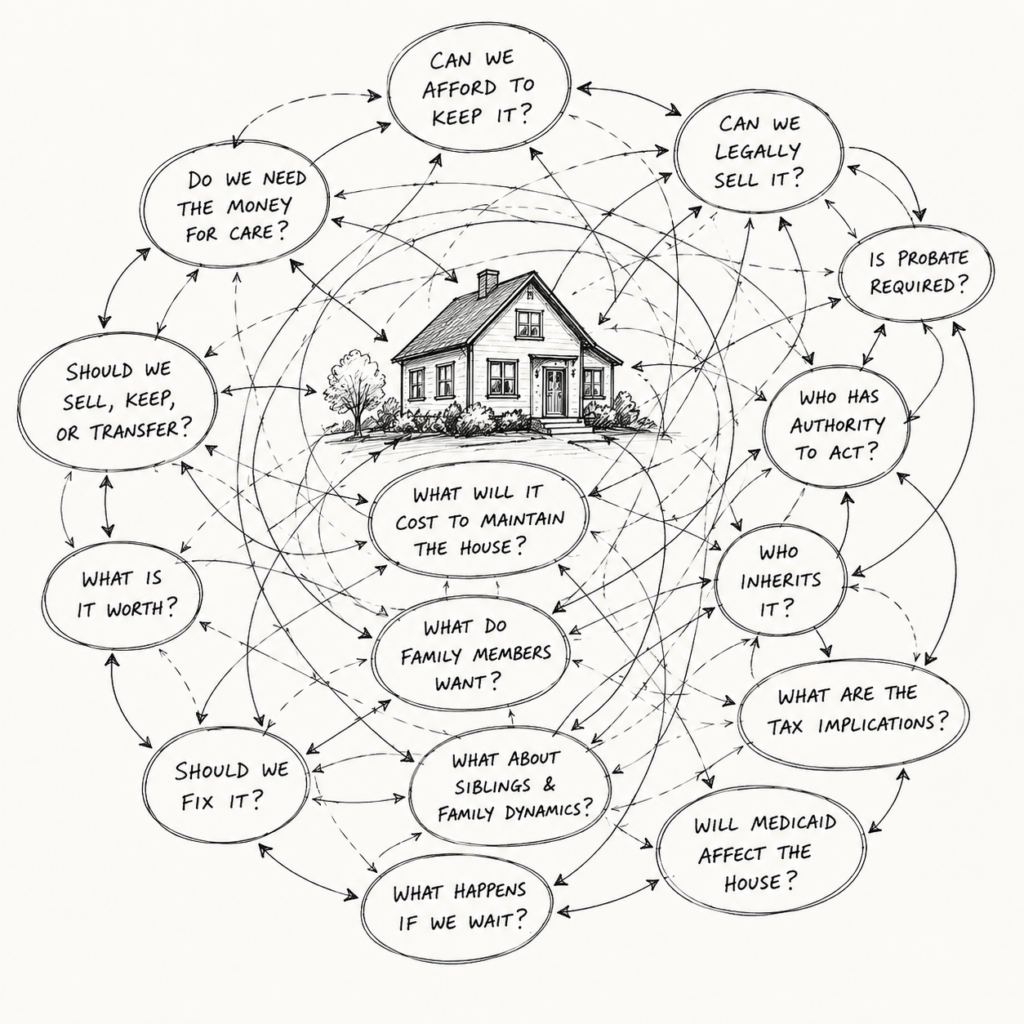
Why Families Get Stuck On What To Do With The House
The problem isn’t a lack of caring.
It isn’t even a lack of information.
It’s a lack of organization.
Everyone seems to have a piece of the answer.
The attorney explains the legal process.
The financial advisor discusses taxes.
The hospital discharge planner focuses on care.
The real estate agent explains the housing market.
Family members each have their own priorities and opinions.
Every perspective is valuable.
Every perspective solves an important part of the problem.
But almost no one is responsible for helping families understand how all of those pieces fit together before a decision gets made.
That’s the gap.
Everyone has one piece.
Nobody has the map.
The Discovery Towards A Solution
After years of encountering these situations in both healthcare and real estate, Alex Craig began noticing the same problem repeatedly.
Families often didn’t lack options. They didn’t necessarily lack information, either.
They lacked a way to organize the information before making a decision.
The attorney understood the legal issues. Healthcare professionals understood care needs. Financial and tax professionals addressed their respective questions. Real estate professionals understood the property.
Each perspective mattered.
But the person suddenly responsible for Mom, Dad, an estate, or a house still had to figure out how all of those pieces fit together.
That observation became the basis for the Home Transition Framework™.
Alex began developing the framework from his combined experience in healthcare and real estate and continued refining the ideas through work involving inherited property, probate, aging-related housing decisions, conversations with families, and educational discussions with professionals working in related fields.
The framework eventually became the conceptual foundation for Alex’s book, What To Do With The House, and for his broader work exploring what happens when responsibility for another person’s home, property, care, or affairs suddenly shifts.
What Is the Home Transition Framework™?
The Home Transition Framework™ is a decision-making framework created by Alex Craig to help families organize the legal, financial, property, caregiving, and family questions that can surround a home during a major life transition.
It is not intended to provide legal, financial, tax, healthcare, or other professional advice.
Instead, the framework helps organize the situation around five questions:
- Authority — Who has the authority to make decisions?
- Stability — What needs attention now to protect the person, property, or situation?
- Understand — What information do we need before making a decision?
- Evaluate — What options are available, and what questions should be considered when comparing them?
- Aligned Execution — Once a decision has been made, what people, professionals, and resources are needed to carry it out?
The framework doesn’t begin with an answer about whether a house should be sold, kept, rented, repaired, or transferred.
Its purpose is to help families better understand the situation surrounding the house before making that decision.
Who Created the Home Transition Framework™?
The Home Transition Framework™ was created by Alex Craig, founder of Dolinski Group, a Michigan real estate investor, licensed real estate professional, and Registered Nurse.
Alex’s professional experience placed him in two very different settings where responsibility can change quickly.
In healthcare, he has worked with patients and families facing serious illness, hospitalization, rehabilitation, dementia, changing care needs, and questions about what happens after someone can no longer safely return home.
In real estate, Alex encountered inherited homes, probate property, aging-related housing decisions, family ownership issues, and properties that suddenly became someone else’s responsibility.
Although the settings were different, Alex noticed a recurring problem:
Someone’s life had changed — and someone else was now responsible for figuring out what happened next.
The house was often only one part of that responsibility, but it was frequently where legal, financial, caregiving, family, and practical questions collided.
Alex has continued exploring those intersections through educational conversations with Michigan probate and estate attorneys, involvement with professionals working in eldercare and estate planning, and the development of resources including **Estate Compass™** and *What To Do With The House*.
The Home Transition Framework™ became the organizing model behind much of that work.
From Real Estate Problem to Broader Responsibility
The Home Transition Framework™ originally grew from a recurring real estate question: What do we do with the house?
But the work surrounding that question revealed something broader.
Families weren’t struggling only because they didn’t know what to do with real estate. They were often struggling because responsibility itself had changed.
Someone had died.
Someone had become incapacitated.
A parent needed care.
An adult child had become responsible for property, paperwork, finances, belongings, appointments, or an estate.
That distinction has increasingly shaped Alex’s work beyond Dolinski Group.
Dolinski Group remains Alex’s primary real estate acquisition and investment company. The Home Transition Framework™, Estate Compass™, What To Do With The House, and related educational work reflect Alex’s broader interest in helping people understand and organize periods when responsibility for another person’s affairs suddenly shifts.
The framework is built around five questions.
1. Authority: Who can legally make decisions about the home?
Every transition begins with authority.
Before decisions can be made, someone must have the legal ability to make them.
Depending on the situation, that may be a personal representative, trustee, power of attorney, conservator, guardian, or the homeowner themselves.
The goal is simple: Prevent families from acting before they have the authority to do so.
2. Stability: What needs Immediate Attention?
Major life transitions create disruption.
Bills continue.
Insurance may change.
The home may sit vacant.
Repairs don’t stop simply because life became complicated.
The purpose of this stage isn’t optimization.
It’s protection.
Protect the people.
Protect the property.
Protect the estate.
Create breathing room before making long-term decisions.
3. Understand: What do we need to know before making a decision?
Good decisions require good information.
This stage focuses on gathering the facts that matter.
That may include:
- Property value
- Condition of the home
- Title issues
- Probate requirements
- Medicaid considerations
- Tax implications
- Mortgages and liens
- Family goals
- Care needs
- Available resources
The objective isn’t information for its own sake.
It’s creating enough clarity to evaluate the available options responsibly.
4. Evaluate: Which path best fits our goals and circumstances?
Only after the situation is understood should the decision itself be made.
Sometimes selling is the best option.
Sometimes keeping the home makes more sense.
Sometimes renting, transferring ownership, delaying the sale, or making repairs creates a better outcome.
The framework doesn’t begin with an answer.
It helps families discover the answer that best fits their unique circumstances.
5. Aligned Execution: How do we move forward together?
Once a decision has been made, the final step is execution.
This often involves coordinating family members and professionals including:
- Attorneys
- Financial advisors
- Accountants
- Care managers
- Contractors
- Movers
- Estate sale companies
- Real estate professionals
Everyone works from the same plan because the plan was built on clarity — not pressure.
Who Is the Home Transition Framework For?
The framework was created for people who suddenly find themselves responsible for decisions they never expected to make.
Executors.
Personal representatives.
Adult children caring for aging parents.
Trustees.
Family caregivers.
People inheriting a home.
It is equally valuable for the professionals who serve those families — including real estate agents, elder law attorneys, financial advisors, senior move managers, care coordinators, and others helping families navigate complex transitions.
Beyond the Framework: The Role of a Home Transition Advisor™
As the framework evolved, another need became clear.
Families didn’t just need information.
They needed someone who could help them organize the situation before decisions were made.
That’s the role of a Home Transition Advisor™.
A Home Transition Advisor doesn’t replace attorneys, accountants, financial advisors, or real estate professionals.
Instead, they help families understand how those professionals fit together.
They help organize the process, identify the next decision, coordinate resources, and guide the transition from uncertainty to action.
In practice, that may include evaluating housing options, creating a realistic timeline, coordinating logistics, connecting families with trusted professionals, and ensuring decisions remain aligned with the family’s goals throughout the transition.
The goal isn’t to take over the decision.
It’s to help families make better ones.