
Updated: September, 2026
A complete, structured framework for Personal Representatives, Executors, and families navigating the estate settlement process.
What Is Estate Compass™?
The Estate Compass™ is an educational framework and Executor Operating System (Executor OS) created by Alex Craig to help people organize the many tasks, records, decisions, and responsibilities that can arise after someone dies.
It combines the COMPASS framework, the executor OS toolkit, and a clear sequence of steps that guide you from day one to final settlement.
Most Executors inherit the role suddenly, with no training, minimal instruction, and overwhelming responsibility. Estate Compass™ replaces uncertainty with an organized system—so you know what to do, when to do it, and how to keep everything on track.
Why Alex Created the Estate Compass™
Estate Compass™ grew out of Alex Craig’s work at the intersection of real estate, healthcare, inherited property, and changing family responsibility.
As a Michigan real estate professional, Alex encountered Executors and families responsible for inherited homes and estate-owned property. As a Registered Nurse, he also saw how illness, incapacity, aging, and death can suddenly shift responsibility for another person’s affairs to a family member.
Those experiences raised a broader question: How do you keep track of everything when you suddenly become responsible for someone else’s affairs?
Alex began developing tools and frameworks for organizing those responsibilities and has continued learning about the process through educational conversations with Michigan probate and estate attorneys and involvement with professionals working in eldercare and estate planning.
Estate Compass™ grew from that work.
It is intended to provide organization — not professional advice — so Executors and families have a clearer way to track what they know, what still needs attention, and which questions need to be taken to an attorney, accountant, financial advisor, or other professional.
It gives families the structure, sequence, and tools to manage the estate confidently — without guessing, Googling every step, or losing track of key decisions.
Who Created Estate Compass™
Estate Compass™ was created by Alex Craig, founder of Dolinski Group.
Alex is a Michigan real estate investor and licensed real estate professional, a Pricing Strategy Advisor (PSA), and a Registered Nurse with a Bachelor of Science in Nursing from the University of Michigan–Flint.
His real estate work has included inherited and estate-owned property, property valuation, investment, renovation, and transactions involving complicated ownership or family circumstances.
Alex has also created educational discussions with Michigan probate and estate attorneys on probate, inherited property, and estate administration and is involved with Lansing Eldercare Planning Council.
Estate Compass™ is part of Alex’s broader educational work around what happens when responsibility for another person’s property and affairs shifts because of death, incapacity, aging, or other circumstances.
Estate Compass™ is currently published through Dolinski Group. Dolinski Group’s primary business is Michigan real estate acquisition and investment.
The framework grew out of:
- Thousands of conversations with families managing estates
- Deep familiarity with Michigan probate patterns
- Direct experience helping executors through property-related tasks
- A background in systems design, real estate processes, financial tracking, and helping people navigate transitions as a Registered Nurse.
- Collaboration with Michigan attorneys, fiduciaries, and advisors
Estate Compass™ represents the best practices, repeatable patterns, and optimized workflows that consistently helped families move from chaos to clarity to completion.
What Estate Compass™ Is (and What It Isn’t)
The Estate Compass™ is a structured framework for settling an estate, a complete executor operating system, and a methodology for creating order and reducing overwhelm. It is a practical toolset to help executors track money, tasks, documents, timelines, and communication.
It works for probate and non-probate estates, simple or complex scenarios, and any family that needs structure.
The COMPASS Framework
The foundation of the Estate Compass™ system is the COMPASS Framework, a seven-part process representing the full lifecycle of settling an estate.
Each step builds on the previous one. Together, they create an estate roadmap that is easy to follow and hard to get lost within.
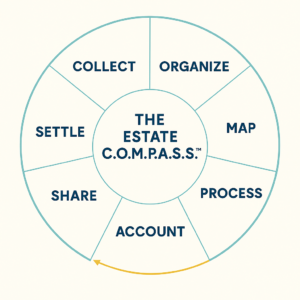
C: Collect
Gather essential documents, accounts, access, authority, and information. This step removes early chaos and creates a solid starting point.
Examples:
- Will, trust, legal documents
- Letters of Authority
- Property deeds
- Account statements
- Insurance information
- Tax records
Goal: Establish the foundation for everything that follows.
O: Organize
Organizing transforms a pile of paper into a structured inventory. Sort what you’ve collected into clear categories:
- Assets
- Debts
- Legal documents
- Beneficiaries
- Accounts
- Property details
Goal: Order replaces overwhelm.
M: Map
Build the estate roadmap. This is where the Executor sees the estate as a clear sequence of tasks and decisions.
Mapping includes:
- What must be done immediately
- What requires probate
- What depends on the court
- What tasks require professionals
- What items affect property sale timelines
Goal: Confusion becomes clarity.
P: Process
Execute the administrative tasks that move the estate forward:
- Notifications and reporting
- Inventory and valuation
- Property decisions (repair, sell, maintain)
- Filing requirements
- Paying necessary expenses
- Coordinating with professional
Goal: Estate movement. No stagnation, no missed deadlines.
A: Account
Accurate accounting protects the Executor and simplifies final reporting. Track all money entering and leaving the estate:
- Receipts
- Bills
- Property expenses
- Reimbursements
- Transactions
- Sales proceeds
- Supporting documents
Goal: Transparency and compliance.
S: Share
Poor communication creates conflict. Clear communication creates cooperation.
Communicate clearly with beneficiaries:
- Updates on progress
- Decisions and reasoning
- Documentation
- Timelines
- Requests for information
Goal: Protect relationships, reduce misunderstandings.
S: Sustain until Settled
Finalize the estate:
- Distributions
- Accountings
- Closing accounts
- Final documentation
- Estate closure both legally and emotionally
Goal: Completion.
The Executor OS — The Operating System Behind the Framework
Beyond the COMPASS steps, Estate Compass™ includes a set of structured tools—the Executor Operating System (Executor OS):
The Executor OS includes:
- A centralized control dashboard
- Asset and debt tracking logs
- Expense and reimbursement tracker
- Document inventory system
- Timeline planning tools
- Key decision worksheets
- Michigan-specific estate considerations
- Complete spreadsheet to handle most executor tasks
The Executor OS is the engine that powers the framework. It is what keeps the estate on course when life feels chaotic.
Who Estate Compass™ Is For
Estate Compass™ supports:
- Personal Representatives
- Executors
- Successor Trustees managing property
- Adult children settling a parent’s estate
- Families navigating probate
- Anyone who has inherited a home
- Beneficiaries coordinating together
- Out-of-state Executors managing a Michigan estate
If you are responsible for settling an estate—or expect to be—Estate Compass™ gives you the clarity and structure you need.
The Purpose of Estate Compass™
The purpose is not to make the estate simple — because it isn’t. The purpose is to make the estate manageable, organized, and clear.
For example, an executor might use Estate Compass™ to:
- List known assets and identify which ones are subject to probate
- Track outstanding debts and creditor information as notices are received
- Document key dates, filings, and responsibilities tied to estate settlement
- Maintain a clear record that can be shared with attorneys, heirs, or advisors
It gives Executors:
- Confidence
- Direction
- Order
- Protection
- A way to move forward
If you don’t know where to start, start with a Compass.