
Updated December, 2025
Outside of probate attorneys, most of us only go through the probate process once. For many families, the process feels overwhelming — full of new legal terms, filings, and financial decisions. Mix all of that with the emotional-side of grief and loss and it’s a lot.
As a real estate professional who regularly guides families on the real estate aspects of going through probate, I have seen how the right attorney can ease stress, protect the estate, and keep the process moving.
One of the first and most important steps in your probate journey is hiring and selecting the right probate attorney.
Whether you’re looking for a Lansing probate attorney or an attorney in the U.P., this guide will help you understand:
- Whether you actually need a probate attorney in Michigan
- How the right probate attorney can make a difference
- What probate lawyers do (and don’t do)
- How much a probate attorney costs
- How to find probate attorneys
- View 2025 Ingham County probate filing data
- How to actually qualify a probate attorney and it may not be the way you think
Do I Need a Probate Attorney in Michigan?
The honest answer is: It depends. And probably.
Let me be clear up front — I am not an attorney. My work and Dolinski is in real estate, not law. This gives me a measure of unbias here and a unique perspective.
Recommending you hire a probate attorney doesn’t put money directly in my pocket — it’s simply the pattern I’ve seen again and again working alongside families trying to sell their home in probate and their attorneys.
So, do you always need a probate attorney? Not necessarily. The better question is, “How much involvement do I need from a probate attorney?”
- For “simple” estates, you might only need a one-hour consultation to get your bearings.
- More complex estates may need ongoing legal guidance throughout the process.
Can I Do Probate Myself?
Yes — in Michigan, families sometimes attempt probate on their own, especially in very simple cases:
- Small bank accounts only
- No property involved
- No debts or disputes
If that’s your situation, a “DIY probate” approach may be possible. Through some research you may be able to fill out the necessary probate filing paperwork with Ingham County Probate court.
But in my experience, those situations are rare. Most estates involve at least one of the following:
- No will or unclear documents
- Debt that must be paid off
- A house or real estate that needs to be sold or transferred
- Disputes among heirs
The vast majority of estates involve enough complexity — especially real estate — that professional legal help is necessary at some stage, regardless of whether the estate goes through formal or informal probate.
Hiring a probate attorney for some part of the process isn’t just helpful — it’s usually essential.
What A Probate Attorney Can Do
Probate attorneys in Michigan, like in Lansing or Downriver, typically help file and manage court documents with the respective courts. For example, if your loved one passed away in Lansing, a probate attorney will file the requisite paperwork with Ingham County probate courts.
In addition, they can guide a personal representative on their duties and deadlines. Most importantly, they can help a personal representative obtain letters of authority.
The right probate attorney saves the estate through process efficiency and speeds up the Michigan probate timeline, even if their fee is initially higher.
One of the biggest costs of probate is carrying costs on property in the form of taxes, insurance, mortgage and utilities. In some cases, that is why a fast estate sale in Lansing may make more sense than waiting to list with a traditional real estate agent.
A probate attorney and probate real estate agent can efficiently move through the process where time is money.
A probate lawyer can offer clear guidance so you don’t pay the wrong creditor. One of our preferred partners shared a story about a client who received a creditor claim and they wanted to pay it. Alongside the attorney, they did more research to discover the claim was false and invalid.
While I do not know the financial numbers involved, it is possible that one event more than paid that Lansing probate attorney’s fee.
Lastly, probate attorneys are trained as mediators and in conflict-resolution. They can help mediate when family disputes arise.
What Your Probate Attorney Does Not Do
A probate attorney is an essential guide through the legal side of probate. They make sure court filings are correct, deadlines are met, and the personal representative has the authority to act. Without that legal foundation, the estate can’t move forward.
But it’s important to remember: attorneys are not the only professionals involved, and they cannot carry every part of the process for you.
Here are a few examples:
- Grief and Emotional Support: An attorney can be compassionate, but they can’t walk you through the personal grief of losing a loved one. That’s where family, community, or grief counselors play a role.
- Estate Cleanout and Junk Removal: Attorneys may refer you to trusted companies, but they won’t be the ones emptying a garage or coordinating a cleanout.
- Real Estate Decisions: They can confirm you have legal authority to sell, but they won’t market, list, or negotiate the sale of the home. That’s where a real estate professional, like Dolinski, comes in.
- Financial Choices: While an attorney can explain the rules, the personal representative must ultimately make the wise financial and emotional decisions on behalf of the estate.
Think of it this way: the attorney provides legal authority, other professionals provide practical services, and you provide the judgment, wisdom and leadership to bring it all together.
A strong attorney will not try to do everything. Instead, they’ll educate you, guide you, and refer you to the right partners so that the estate moves forward with clarity and confidence.
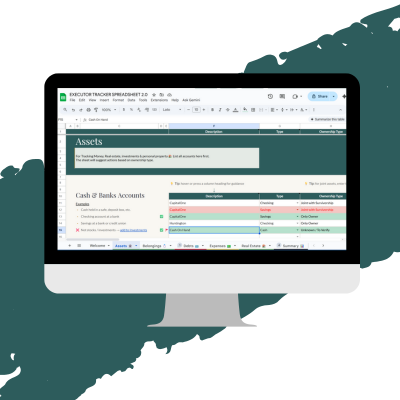
To save time and money, it’s a good idea to take on the responsibility of organizing the estate. We’ve designed a spreadsheet to help you manage and settle an estate after the death of a loved one.
Stay Organized Settling an Estate
Use our Executor Tracker to log dates, payments, and court actions — it keeps everyone on track.
When Should I Talk To A Probate Attorney
You should begin conversations with a probate attorney as soon as possible. However, it is common, due to the emotional aspects of probate, for families to freeze and think, “If I just don’t do anything, maybe this will go away”.
Unfortunately, the need for probate doesn’t disappear. In fact, it usually makes things worse. Property taxes and ongoing maintenance expenses pile up, creditors begin to file claims against the estate, family disputes or tensions compound, and the court may need to intervene.
It is a good idea to start talking with a probate attorney if:
- The estate includes a house or significant assets.
- Creditors are contacting you.
- Family members are disagreeing.
- You’re unsure what the next step is.
Early guidance prevents avoidable mistakes and gives families peace of mind. In fact, delaying probate is one of the costliest mistakes in probate.
How Much Does a Probate Attorney Cost In Michigan?
When considering an attorney, one of the most common questions families ask is: “How much will probate cost in Michigan?” The answer depends on the estate’s complexity, location of the estate, and how the attorney structures their fees.
Here are the most common billing methods you’ll encounter in Michigan:
Hourly Billing
Many probate attorneys bill by the hour. Rates in Michigan often fall between $150 and $400 per hour, depending on experience and location. In places like Birmingham or Detroit suburbs, rates tend to be higher than what you might see in Lansing.
Rarely will a Lansing probate attorney be an apples-to-apples comparison to a Downriver probate attorney. Expertise will be layered into the pricing so it is possible to see higher billing rates in lower cost-of-living areas.
Best fit: When the estate is relatively straightforward and you only need an attorney’s time for certain filings or hearings. For example, you may only need a one-hour consultation to get your bearings and complete some filings.
Watch for: If the estate drags out or disputes arise, hourly charges can build quickly.
Flat Fee
Some attorneys offer a flat rate for handling uncontested, smaller estates. Flat fees often fall between $2,000 and $7,000, depending on the scope.
Best fit: When you want predictable costs and clear boundaries on what services are included. Often specialized probate firms utilize legal aides for day-to-day work, which can allow firms to reduce their flat-fee price while providing top-notch service.
Watch for: Ask exactly what’s covered. Sometimes tasks like handling real estate or unexpected disputes fall outside the flat fee. It may also include a limited number of hours consulting with the attorney before they begin to bill the estate hourly.
Always ask for a written fee agreement upfront. A good attorney should explain whether their fees include court costs, staff time, or just legal services.
Percentage of the Estate
This model is less common in Michigan but may apply for larger or more complex estates. Attorneys charge a percentage of the estate’s gross value, usually between 2% and 4%.
Best fit: When the estate is large and complex. It cannot be handled by flat-fee and predicting hourly billing is impossible.
Watch for: “Gross value” means total assets before debts are subtracted. So, an estate with $3 million in assets and $3 million in debt would still be billed as if it were worth $3 million. May not be suitable if there is limited money in the estate.
Blended or Hybrid Models
Sometimes attorneys combine fee structures. For example, they might charge a flat fee for the basics, then switch to hourly billing if the case goes beyond the original scope.
Best fit: When you want the security of a flat fee but understand there may be additional costs if the case becomes more complex.
How To Find A Probate Attorney In Michigan
Let’s talk about some practical tips for finding a probate attorney — existing legal paperwork, referrals, and searching online.
Search The Will
Roughly 65–70% of Michiganders pass away without a will. For those whose loved ones are among the minority, there may be some comfort in knowing a will exists. Often that will was prepared with the help of an estate attorney — for example, a Lansing estate attorney who focuses on wills and trusts.
It’s important to understand the difference between estate attorneys and probate attorneys:
- Estate law focuses on planning before death: drafting wills, trusts, and other documents to guide the future distribution of assets.
- Probate law deals with what happens after death: navigating the court process, obtaining letters of authority, paying debts, and distributing property.
In many cases, the same attorney or firm practices both estate planning and probate administration. That makes it natural to start by contacting the attorney who drafted the will. They may be a good resource, especially if the documents are current and they still practice actively in this area.
But it’s worth pausing here. Just because a Lansing estate attorney prepared the will doesn’t automatically mean they are the best fit to guide you through Ingham County probate today. A will written five, ten, or even twenty years ago is still legally valid, but circumstances change:
- The attorney may have retired or shifted away from probate work.
- They may be a general practice lawyer who drafted a simple will but does not specialize in probate administration.
- Your family’s situation may now involve debts, real estate, or disputes that require deeper probate experience.
For these reasons, it’s wise to approach probate attorney selection as a research and qualification process.
The attorney who drafted the will might still be the right choice — but they might not. The goal is to ensure you have the most qualified guide for the road ahead.
Getting Referrals
The next place to find some potential probate attorneys are through friends, families and other professionals.
You may have a friend who recently navigated the probate process after a loved one passed away. Even if they cannot give you a solid recommendation, perhaps they can steer you away from potential probate firms.
In addition, you may ask your CPA, financial advisor or other adjacent professionals.
It is common for local attorneys to network with other professionals through BNI or the local chamber of commerce. A Lansing financial advisor, for example, who helps families budget, save and build wealth is often the same person guiding clients through decisions about estate planning and inheritance. These planners regularly collaborate with probate and estate attorneys as clients ask how to pass on assets to their heirs.
If you know a lawyer in another field, they may have a trusted network and can provide a referral to a respected probate attorney. For example, a Lansing business attorney may be able to refer you to a Lansing probate attorney or a Downriver probate attorney.
Probate touches multiple areas of life — financial, legal, and personal. Asking for referrals within your existing network often leads to recommendations.
Search Online
Statistics vary, but the data shows a sufficient percentage of personal representatives are managing the probate process either in a different state or more than an hour’s drive away.
The rough estimate is that nearly 30–40% of Michigan probate cases involve a personal representative who is either out of county or out of state. Given the population trends in Michigan, I suspect the numbers will continue to grow.
Since people are moving away for jobs and parents remain in the family home, Wayne and Ingham County note it is common for the personal representative to live outside the county.
Anecdotally, these statistics feel right from my experience. I have worked with a personal representative in Texas to sell a home in Michigan. I have worked with an adult-child in Ohio to help him sell his father’s property to support paying for long-term care.
Perhaps because of our online presence, Dolinski clients tend to be from other geographic regions than where the home is being sold.
Given that roughly 1 in 3 estates are managed by someone who is not local, asking for referrals or looking at the will may not be viable options for finding probate attorneys.
If you’re serving as a personal representative but don’t live in Michigan, referrals may not be as easy to come by. You might not have local friends, family, or colleagues who can point you toward an attorney. In that case, Google and online directories become your primary tools.
Use Google
For those who receive referrals from friends and professionals, it’s still smart to do your own research with Google. For out-of-state representatives often have no choice but to lean heavily on online research — and that’s okay. Done carefully, it can lead you to strong local professionals who will act as your “boots on the ground” throughout probate.
Google and an online search can act as a source and verifier. A quick Google search can help confirm whether an attorney actively handles probate cases. If a name doesn’t appear online or has little information available, that may be a sign they don’t focus on this area of law.
When searching, try terms like “probate attorney Lansing MI”, “Lansing probate attorney” or “Ingham County probate attorney.” Adjust the city or county to match your situation.
Typically, your search will bring up three main types of resources:
- Attorney Websites: Visit firm websites to review attorney bios, their probate experience, and whether probate or estate law is a core practice area. Look for details beyond just “general practice.”
- Professional Directories: The State Bar of Michigan’s member directory allows you to search by location and practice area. Enter your city or county and “probate” to generate a list of licensed specialists nearby.
- Specialized Platforms: Some national legal sites, like Avvo or LegalZoom, maintain listings of probate attorneys and often include reviews or general fee information. These can be useful for comparison, though they shouldn’t replace local due diligence.
Think of online research as a way to verify and compare. Referrals give you names, but Google helps you see who is active, specialized, and transparent about their work.
What Ingham County Probate Data Shows
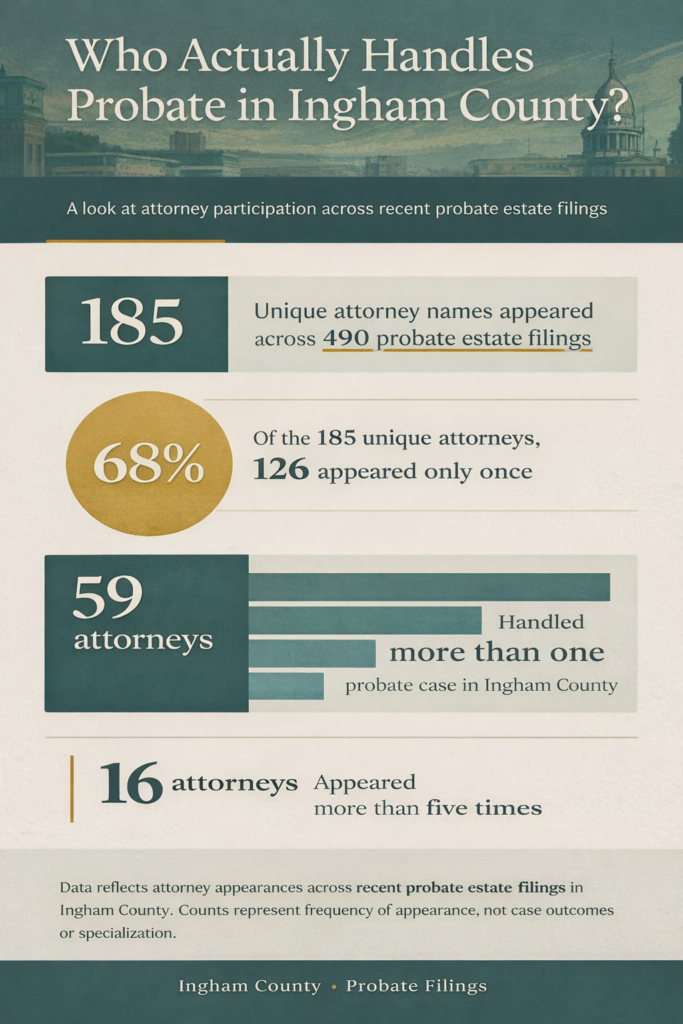
To better understand how probate administration actually works in Lansing—and more specifically in Ingham County—we reviewed 490 probate estate filings opened in 2025 and analyzed which attorneys and law offices appeared in court records.
This review included all estate cases opened between January 1, 2025 and December 15, 2025. Filing volume during this period is consistent with Ingham County probate activity in recent years, making the dataset representative rather than anomalous.
Methodology
We reviewed publicly available probate estate filings and grouped appearances by both individual attorney name and law office address to account for firms that distribute probate administration among multiple attorneys.
We did not formally look at date-of-death data or determine how long probate took for these cases.
Before reviewing the data, we had two working assumptions or hypotheses:
- Probate and estate administration would be dominated by the same attorneys and firms that rank highly for searches such as “probate attorney” or “estate planning attorney.”
- Probate administration would be heavily concentrated; where a small number of attorneys handled the majority of cases.
The data did not support either assumption.
What follows below is not an attorney recommendation. Dolinski Group is not endorsing, ranking, or recommending any attorney or law office based on filing counts or frequency.
This data should be used as a starting point for research — to generate interview questions, understand patterns in probate administration, and help families verify fit based on their specific needs.
Our goal was to analyze Ingham County probate court filings to better understand how probate administration actually occurs in practice.
Data Source
All data was sourced directly from publicly available Ingham County probate case records, specifically estate and decedent estate filings. Filings were manually reviewed and grouped by both individual attorney name and law office address to account for firms that distribute probate work across multiple attorneys.
This analysis reflects what appears in court records, not the internal structure, seniority, or role of attorneys within a firm.
Dolinski Group has collaborated on educational probate content with several Michigan probate attorneys, including Nicholas Leydorf and Emily Nestor. Inclusion of any attorney or firm in this dataset does not imply endorsement, referral, or recommendation.
Results were compiled independently and were not influenced by pre-existing relationships.
Attorney Findings
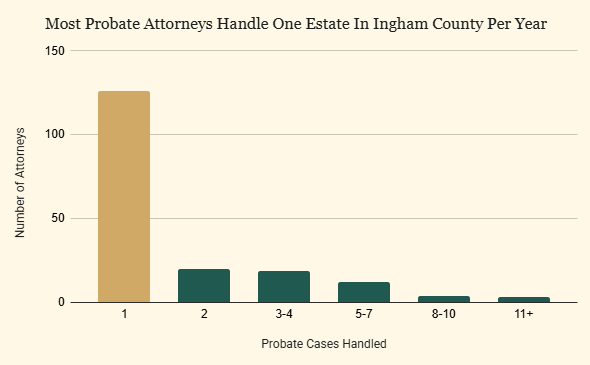
Most surprising, the dataset was dominated by attorneys who handled only one or two estate administration cases per year.
Of the 16 attorneys that appeared more than five times, they handled approximately 125 probate cases or about 25 percent of the total probate estate administration filings in Ingham County.
68% of probate attorneys appeared on only one Ingham County filing in 2025.
| Attorney | Probate Filings (2025) |
|---|---|
| Sara Reedy | 15 |
| Nicholas Leydorf | 11 |
| David H. Jones | 11 |
| Darren Findling | 10 |
| Joseph Cooper | 9 |
| Eric Holmes | 8 |
| Nicole LaRuwe | 8 |
| Melissa Patrick | 7 |
| Ashley Kagey | 7 |
| David Brake | 7 |
| Katrina Hofstetter | 7 |
| Byron Gallagher | 7 |
| Christine Savage | 6 |
| Robert S. Hollander | 6 |
| Kent Wood | 6 |
| Amanda Frost | 6 |
Law Offices
In addition to individual attorneys, we reviewed filings by consistent law office addresses. This revealed a second pattern: some firms centralize probate work with a single attorney, while others distribute filings across multiple attorneys within the same office.
The ten law offices that appeared the most of the legal filings were:
| Law Office | Probate Filings (2025) |
|---|---|
| Buhl, Little, Lynwood & Harris PLC | 18 |
| Family & Elder Law of Mid-Michigan | 15 |
| Foster Swift Collins & Smith | 15 |
| Gallagher Law Firm | 14 |
| David Jones Attorney | 12 |
| Leydorf Law Firm | 11 |
| The Probate Pro – Darren Findling | 10 |
| Noud & Noud Law Firm | 9 |
| Chalgian & Tripp Law Offices PLLC | 8 |
Some offices showed strong consistency between firm and attorney—for example, Noud & Noud filings were primarily handled by Joseph Cooper. If you compare the two tables, you will see that Joseph Cooper filed 100% of the probate estate administration documentation at Noud & Noud Law Firm.
Other firms, such as Buhl, Little, Lynwood & Harris, appeared across multiple probate filings with different attorneys, suggesting internal distribution rather than reliance on a single probate-focused attorney.
Implications: How to Use This Data
This data highlights an important—and often overlooked—reality of probate administration:
- Many attorneys handle probate occasionally, not continuously
- Even large estate planning firms may process probate cases infrequently at the individual attorney level
- Probate administration experience varies widely, even within the same law office
For families navigating probate, this reinforces the importance of asking specific questions about experience, rather than assuming all probate attorneys handle estate administration at the same volume or frequency.
It also explains why many families discover—often months later—that while probate administration is complete, decisions about real estate are still unresolved.
Important Context: What This Data Does Not Explain
It’s important to understand what this data can and cannot tell us.
Court filing data shows what happened (who appeared on filings and how often), but it does not explain why probate administration was handled that way.
For example:
- Some law offices may distribute probate administration among multiple attorneys, including junior or associate attorneys.
- In other cases, an attorney may appear infrequently not because probate is uncommon for them, but because they limit the number of estates they accept.
- Some filings may reflect unusual circumstances, such as related family estates, delayed probates, or administrative substitutions.
Because of this, filing frequency alone should not be used to assume:
- Relative skill or quality
- Seniority within a firm
- How involved an attorney was in the day-to-day administration
- Whether probate is a core focus of a particular practice
Selecting A Probate Attorney: What To Look For
When it’s time to narrow down a list of potential probate attorneys, the decision shouldn’t rest only on specific credentials, cost or qualifications.
It is not about the law school they went to or how many years they have been in practice. These matter, but may not be the only factor.
Instead, you are looking for ways to judge whether a probate attorney has the expertise, trust, competence, and values to help you and your family navigate probate.
An attorney who brings both competence and compassion will not only keep the estate on track but also ease the stress that naturally comes with this season of life.
Every part of your evaluation should focus on four key areas:
- Expertise: Do they have direct experience handling probate cases in your county? How many estates do they administer each year? Do they understand the nuances of local courts like Ingham or Wayne County?
- Trust: Do they explain probate in plain English and return calls promptly? Do you feel they’re listening to your concerns, or rushing you through? Trust is built as much on communication as on legal knowledge.
- Competence: Probate is rarely straightforward. Does this attorney seem proactive in offering solutions, or are they reactive and vague? A good attorney should give you confidence that they can guide you through obstacles as they come.
- Values: Most importantly, do their values align with yours? Probate should be handled with clarity, compassion, and steadiness. If an attorney treats your family as just another case file or seems motivated only by fees, that’s a red flag. The best probate attorneys approach their work the same way we do: putting families ahead of transactions.
Choosing the right probate attorney is about more than legal authority — it’s about finding someone whose skills and values fit your family.
Questions to Ask a Probate Attorney
From researching online to formally sitting down with a probate attorney, you want to answer the four key areas of expertise, trust, competence, and values. Some questions you can directly ask a probate attorney to discover these four areas are:
- How many probate cases do they handle each year in Lansing?
- How much of your practice is probate law?
- How familiar are you with Ingham County Probate Court?
- What is your billing structure?
- Who on your team will be handling my case?
- How do you coordinate with real estate professionals?
- What’s your typical timeline for estates involving property?
- How do you handle disputes if they arise?
Choosing a Probate Attorney Who Shares Your Values
At Dolinski, we believe probate isn’t just about paperwork — it’s about people. That’s why we encourage families to look beyond credentials and fees when selecting a probate attorney. The right attorney should share the same values that guide our work every day:
- Clarity over confusion: Explaining the process in plain English, not legal jargon.
- Compassion over commission: Remembering that families are grieving, not just signing forms.
- Steadiness over salesmanship: Offering calm guidance rather than pressure or hype.
When an attorney operates from these values, the probate process runs smoother and families feel supported, not rushed.
Final Thoughts
For that reason, we’ve built relationships with probate attorneys in Lansing and Downriver who embody the same values that guide our work. We call them our Preferred Partners — professionals we’ve watched consistently put families first and approach probate with both skill and compassion.
Because probate is never a one-person job. It takes attorneys, real estate professionals, financial guides, and service providers working together. That spirit of collaboration is why we chose the name Dolinski Group — it reflects not just our internal team, but the network of trusted partners who share our mission of clarity over confusion and compassion over commission.
Learn More About Probate
We don’t practice law. Our role is to help families make steady decisions—especially when a home is involved. We’ve co-created probate educational content with Michigan attorneys (including some listed above). For more guidance on the probate process, visit our Michigan Probate Resource Hub.