
When a loved one passes, one of the first big logistical questions families ask is: “What happens to the house?” Do you have to sell the home in probate or can you keep the home in the family?
The honest answers: it depends.
Several factors determine what happens to real estate in probate, but in most cases it comes down to four things:
- The will and what is says (if anything)
- Whether creditors need to be paid
- Financial feasibility
- Family dynamics and agreement
The legal factor is relatively straightforward, so this guide will focus on the financial realities — the part that is often most complex and surprises families.
The Wills Role in Real Estate
A last will and testament is a legal document designed to direct executors how assets are handled after death. In rare cases, the will is clear about what happens to the family home. For example:
- A will may state the home is to be sold and the proceeds split among heirs after debts are paid
- A home is gifted to a nonprofit or individual outright.
But, here’s the reality: most wills don’t specifically address how real estate is handled. In the best case, a will may contain vague language about all real property that allows discretion when performing Michigan executor duties.
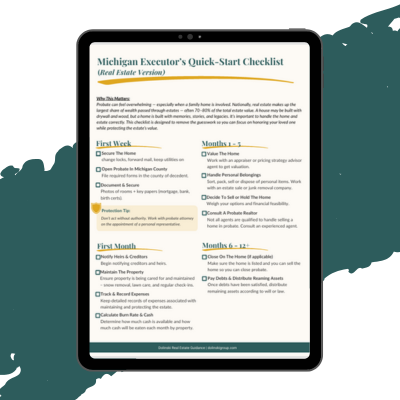
Not Sure Where To Start?
Get the free Michigan Executor Quick-Start real estate version checklist and understand at a high-level what you need to do from the date of death until probate closes.
This means many families are left without direct guidance, making financial and creditor obligations the real deciding factors.
Who Decides What Happens To The Home?
If a loved one left a valid Michigan will, then it most likely named a personal representative or executor. The personal representative or executor is like a project manager for an estate. An appointed individual or group of people will handle common tasks such as opening probate, notifying and paying creditors, and distributing assets to heirs.
The executor has a responsibility to act in the best interest of the estate and its heirs. Therefore, when it comes to keeping or selling the family home in probate, the executor may be the one making the decision. They may determine whether to sell now or wait until after probate.
In cases where court involvement is required, the courts may need to approve of the decision the executor makes. With court oversight, the courts or the judge make the ultimate decision.
The Role Of Creditors On Probate Homes
As Lansing probate attorney, Nick Leydorf, puts it, “People are surprised, but probate really exists to protect the creditors”.
When a loved one dies, their debts don’t disappear. They must pay their debts from the estate’s assets. Debts such as mortgages, credit cards and medical bills are due. The estate may be able to pay off or satisfy their debts with assets such as cash, investment accounts, or through real estate.
So, the key question becomes a math question: “Are there enough assets in the estate to cover the debts without selling the house?”
- If yes, then heirs may have the option to keep the home
- If no, the house needs to be sold or liquidated in order to satisfy creditor obligations, regardless of what the family prefers.
Here is an example estate where the family may be able to keep the home. The estate had $30,000 in cash, $15,000 in credit card bills, and a home worth $200,000 without a mortgage. In this case, the executor can pay the creditors out of the cash assets. The executor would be able to distribute the remaining assets according to the will or state laws.
If multiple family members or heirs are involved, this is where family dynamics and financial feasibility come into play.
Family Dynamics On Probate Home
Even if family members get along, they may not agree on the best course of action or have other priorities in their personal life that bleeds into their approach for handling an estate. Inheriting a property with a sibling has special considerations.
For example, an heir may be working through the financial baby steps trying to achieve financial peace. So, they want their inheritance in cash in order to pay off debt or move through the baby steps. Another family member may wish to hold onto the home.
Whether it’s possible to keep the home depends on the estate’s finances, personal finance of heirs, and creative solutions. Here are some options for when one family member wishes to keep the home and others may not wish to do so:
- Refinance or Buyout: If one heir wishes to keep the home but the other wants cash, you may need to refinance the home and payout the other siblings for their share. You may also be able to pay the heirs their portion through excess cash assets.
- Co-Ownership agreement: This must be done with extreme care and long-term thought. Holding title together in real estate means shared costs, taxes, and decisions. A clear co-ownership agreement is critical to avoid family disputes later.
Passing A Home Outside Probate
In some cases, families will try to pass real estate onto their heirs outside of probate. Examples include ladybird deeds or life estates.
Where families run into issues is when the home is passed outside of probate but debt remains on the home. Specifically, the home is inherited with a reverse mortgage, home equity loan, or standard mortgage.
Debts tied to the property itself must still be paid by the beneficiary. If payments aren’t kept up, the lender may foreclose on the property.
Every loan and lending company is different when it comes to your options. In most cases, the lender will require the beneficiary of the home to qualify for a mortgage.
For example, a $300,000 home is inherited with an outstanding mortgage balance of $50,000. The lender will require the beneficiary to qualify for a refinance or mortgage assumptions.
In other words, you will need to be able to make the debt or mortgage payments. The lender will look at your financial situation as if you were buying a home or getting a loan.
If you can’t qualify for the loan or assume the mortgage, you will most likely need to sell the home. In this case, since the home was passed outside of probate, you can sell the home outside of probate.
Taxes and Costs Can Force The Sale
In a small number of cases, the home may need to be sold in order to cover the cost of taxes and the cost of Michigan probate. From probate attorney fees, to maintenance costs, to property taxes, and more, probate can become an expensive process.
There are times where families are pushed to sell even if they could keep the home. A situation like this arises when there are limited debts and limited assets.
In this case, the only asset may be the home and all of the equity is tied up in the home. It is possible the home needs to be sold to free up cash.
How Long Families Have For Deciding What To Do With The Home
One of the most stressful parts of probate is feeling like you’re on the clock. While every estate is different, Michigan probate tends to follow relatively predictable probate timelines.
- Simple estates: usually 6–12 months from opening to closing.
- Complicated estates: can stretch well beyond a year, especially if there are creditor disputes, tax issues, or disagreements among heirs.
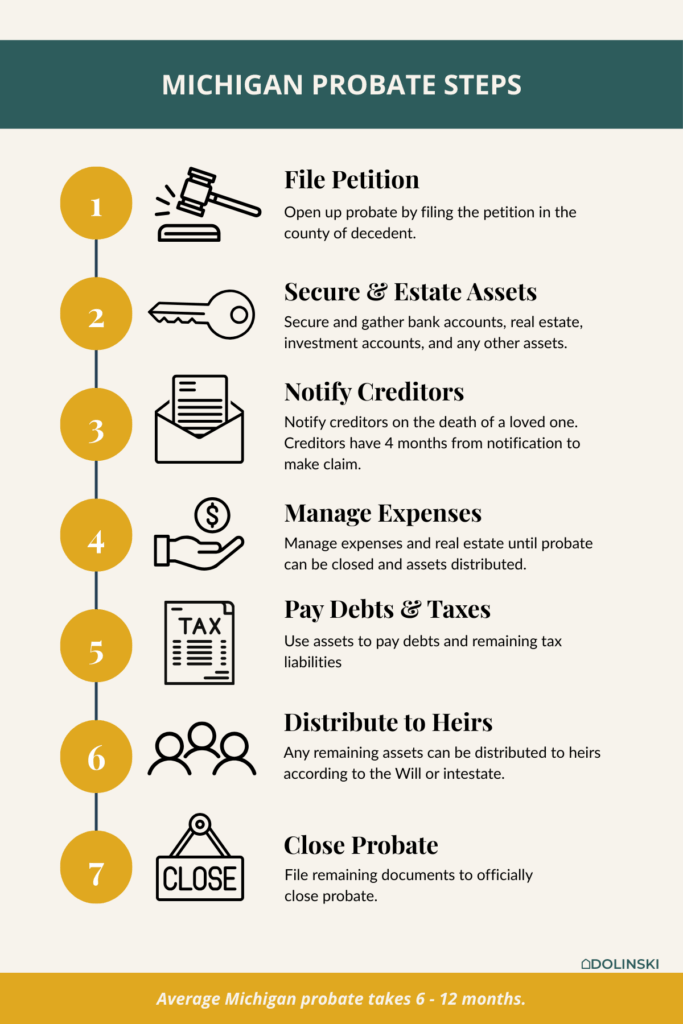
The family doesn’t have the luxury of waiting until probate closes to make decisions about the home. Here’s why:
- Creditors must be paid: the court requires debts to be resolved before assets can be distributed.
- Carrying costs add up: property taxes, insurance, utilities, and upkeep continue as long as the estate owns the home.
- Executor responsibilities: the executor is accountable for protecting the value of the home, not letting it sit vacant and deteriorate.
The longer the decision drags on, the more it costs the estate. Court supervision and legal fees increase if probate stays open. Carrying costs eat away at inheritance.
Failing to make a decision is a major mistake that limits estate proceeds. Every month the home sits unsold or undecided, heirs may see their proceeds shrink.
Final Note
It’s possible to keep the family home in probate. You may not even need to sell it. This article just scratched the surface, but probate can be complex. Visit our Michigan probate resource hub to learn more about probate and real estate.