
Settling an estate is rarely a single task. It’s a process — one that combines legal requirements, financial responsibilities, real estate decisions, and family coordination, often during a time of grief and uncertainty.
If you’ve been named an executor, personal representative, helping a family member navigate what comes next, or are a beneficiary or heir to the estate, this guide will walk you through how estate settlement actually works in Michigan, what steps matter most, and how to avoid common breakdowns that delay or complicate the process.
Rather than treating estate settlement as a checklist of disconnected tasks, we’ll also introduce a practical framework — the Estate Compass™ — that helps executors understand what needs to happen, in what order, and why.
What Does It Mean to “Settle an Estate”?
When people say “settle an estate,” they are usually referring to the full process of wrapping up a person’s affairs after death — not just probate.
An estate represents everything a person owned, owed, and was responsible for at the time of death. To settle an estate means bringing all of those affairs to a proper close.
In Michigan, estate settlement often involves:
- Identifying assets and outstanding obligations
- Determining which assets pass through probate and which do not
- Managing property, including selling a parent’s home and personal belongings
- Paying valid expenses, debts, and required filings
- Distributing remaining assets to heirs or beneficiaries
- Formally closing legal and financial matters
Certain accounts — such as payable-on-death (POD) bank accounts, transfer-on-death (TOD) investments, and life insurance — typically pass directly to named beneficiaries. Keep in mind variations may exist and it is best to consult an attorney.
These assets are still part of the person’s overall affairs, but they may bypass the court process entirely.
Some estates are relatively straightforward. Others become complex due to property ownership, family dynamics, incomplete planning, or real estate decisions.
Understanding this distinction early helps executors avoid confusion and unnecessary delays.
Estate Settlement Happens in Two Journeys
A helpful way to think about estate settlement is like climbing Mount Everest. Reaching the summit is not one single effort — it involves two very different journeys.
The first journey is everything that happens before the climb even begins. Travel arrangements, permits, logistics, and supplies are largely governed by systems that are already in place. Much of this work happens automatically once the proper paperwork is in order.

The second journey is the climb itself. This is the hands-on, step-by-step process that requires active decision-making, coordination, and guidance from experienced professionals.
Settling an estate works the same way.
Some assets move through pre-arranged systems — non-probate transfers — that function much like the journey to the mountain. They follow rules already established through beneficiary designations, ownership structures, or trusts.
Other assets require a formal, court-guided process — probate — where an executor, attorney, and supporting professionals must actively guide the estate through legal requirements, deadlines, and decisions until the process is complete.
Understanding which parts of an estate are already on autopilot — and which require hands-on navigation — is one of the most important responsibilities an executor faces.
In this full length interview with estate attorney Emily Nestor, we talk about probate versus non-probate assets.
Because probate rules vary by state, understanding Michigan-specific requirements early can prevent delays and mistakes later. If probate is part of your estate settlement, our Michigan Probate Hub breaks down timelines, court expectations, and executor responsibilities in plain English.
Your Role as Executor: More Than Paperwork
Being named an executor (or personal representative) does not simply mean filing forms or waiting for instructions from the court. Your role is to manage the estate from start to finish — legally, financially, and practically.
In Michigan, executors are responsible for ensuring the estate is handled correctly, on time, and in the best interest of the heirs.
If you are serving as an executor in Michigan and want to learn more about what that entails. Check out our guide on Executor duties in Michigan.
That includes complying with court requirements, but it also includes coordinating real-world tasks that fall outside the scope of formal probate administration.
This is where many executors feel overwhelmed.
- Attorneys focus on legal compliance and filings.
- Financial institutions focus on their own accounts.
- Contractors, real estate professionals, and service providers operate independently.
The executor becomes the one responsible for connecting all of these moving parts.
In other words, executors don’t just administer an estate — they manage it.
At Dolinski, we use the term estate management to describe the real-world work executors are responsible for after someone passes. It describes the coordinating documents, property, finances, professionals, and decisions until the estate is settled.
Estate management support services describe how we help executors and personal representatives navigate that work with structure, clarity, and guidance.
We explain how estate management differs from traditional estate planning and estate administration, and why families often need support beyond legal filings alone.
Recognizing your role as the manager of the estate — not just a messenger between professionals — is the first step toward settling the estate with clarity and confidence.
A Practical Framework for Settling an Estate
Most estate guides present settlement as a checklist of tasks. In reality, executors don’t complete estate responsibilities in a straight line. Tasks overlap, new information appears, and decisions in one area often affect another.
To bring clarity to this process, we use a simple framework called the Estate Compass™, an executorOS.
It doesn’t replace legal requirements or professional advice — it helps executors understand how the work of settling an estate actually unfolds.
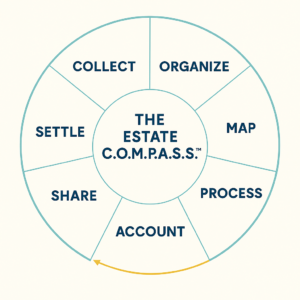
The Estate Compass organizes estate settlement into seven practical phases. These phases reflect the real responsibilities executors manage, rather than forcing everything into a rigid timeline.
- Collect: gathering information, documents, access, and authority
- Organize: identifying assets, obligations, and ownership
- Map: determining probate vs non-probate paths and timelines
- Process: carrying out property, financial, and administrative tasks
- Account: tracking expenses, estate funds, and distributions
- Share: notify heirs and beneficiaries and notify creditors
- Settle: closing the estate legally and financially
Collect: Establishing Control & Access
Most estate settlements begin with gathering information and securing access. This includes obvious documents like wills, death certificates, bank statements, credit card accounts, mortgage information, insurance policies, and recent tax returns.
It also includes less obvious but equally important items — property keys, safe combinations, digital logins, mail access, and account credentials. Executors often discover that critical information is scattered across the home, filing cabinets, email inboxes, or multiple devices.
Delays frequently occur at this stage when records are incomplete, outdated, or difficult to locate. Until documents and access are established, nearly every other estate task is forced to wait.
Organize: Understanding What Exists
Once information is collected, the next step is organizing it in a way that creates visibility. Executors need a clear picture of what assets exist, what obligations remain, and where supporting documents are stored.
This stage isn’t about making decisions yet. It’s about creating clarity.
A simple spreadsheet, document system, or centralized folder can help answer foundational questions: What does the estate own? What does it owe? Which accounts are active? Which properties or belongings require attention?
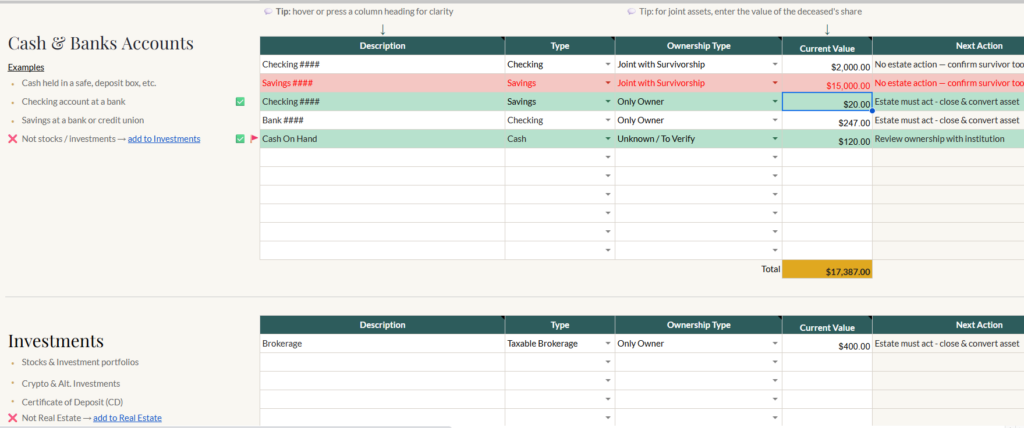
Whether done digitally or offline, organization allows executors to move from uncertainty to understanding before anything is acted upon.
Map: Determining the Legal Path
With assets and information organized, executors can begin mapping the legal path forward. This means determining which assets pass through probate and which transfer outside of court through beneficiary designations, joint ownership, or trusts.
At this stage, it’s important not to rush decisions — especially when it comes to property or belongings. Until authority is confirmed and probate requirements are understood, items should generally remain in place.
Acting too early can create legal or family complications later.
This is also the point where attorney guidance is often most valuable. Understanding the probate process early helps executors avoid missteps that can delay settlement or expose them to risk.
Process: Carrying out the work
This phase represents the bulk of the executor’s workload. It’s where planning turns into action and where estate settlement becomes hands-on.
Common responsibilities include caring for the home, coordinating cleanouts, managing utilities and insurance, deciding whether to sell inherited property, and overseeing the sale or transfer of real estate. Executors must balance timelines, costs, family expectations, and legal constraints — often simultaneously.
Because so many tasks converge here, this phase is where estates most often stall without structure or support.
Account: Protecting the Estate
Accounting is about more than numbers. Executors are responsible for tracking money in, money out, and the decisions made on behalf of the estate.
This includes maintaining records of expenses, payments, reimbursements, property-related costs, and distributions. It is also canceling unused subscriptions or accounts.
It also means documenting actions taken; not just for tax purposes, but to protect the executor if questions arise from heirs or the court.
Clear records create transparency, reduce conflict, and ensure the estate can be closed cleanly.
Share: Inform Everyone
Estate settlement involves ongoing communication with many parties: heirs and beneficiaries, attorneys, courts, financial institutions, and service providers.
Executors are often required to provide updates, notices, and formal filings throughout the process. Clear communication helps prevent misunderstandings, manage expectations, and reduce emotional friction during an already difficult time.
This is the process where probate court forms or “PC forms” (PC-593, PC-598, PC-569, and more) fit in.
Consistent, documented communication is one of the most overlooked — and most important — executor responsibilities.
Settle: Closing the Estate
The final phase of estate settlement is closure. This includes distributing remaining assets according to the will or Michigan intestacy law, submitting any required final filings, closing estate accounts, and formally completing the probate process when applicable.
Only once these steps are complete can the executor be released from responsibility and the estate considered fully settled. While this phase may appear straightforward, it often depends on everything being handled correctly earlier in the process.
How Long Does It Take to Settle an Estate in Michigan?
This is one of the most common questions — and the answer is: it depends.
In Michigan:
- Most probate estates must remain open at least five months to allow creditor claims
- Typical estate settlement timelines range from 5 to 12 months
- Estates involving real estate, disputes, or incomplete records often take longer
That’s where understanding the phases of estate settlement becomes more important than memorizing deadlines.
There are many factors that affect how long it takes to settle an estate. If you’re specifically trying to understand how long probate typically takes in Michigan, court timelines, personal administrators execution and creditor periods play a major role.
Do You Need a Lawyer to Settle an Estate?
Some estates can be settled with limited attorney involvement. Others require formal legal guidance.
In general:
- Simple estates with clear assets and no disputes may only need legal coaching
- Estates involving probate, real estate, or multiple heirs typically benefit from attorney oversight
- Disputes, unclear ownership, or creditor issues increase legal necessity
The key is understanding what attorneys handle versus what executors still manage. Estate settlement almost always involves coordination beyond legal filings.
Before making the decision, consult with an attorney in your applicable jurisdiction to determine if you need an attorney.
How Do You Settle an Estate Without a Will?
Settling an estate without a will follows the same overall process as any estate settlement, but Michigan law determines who has authority and how assets are distributed.

The work still moves through the same practical phases:
Collect & Organize: Gather financial records, property information, and personal details so the estate’s assets and obligations are clearly identified.
Map: Without a will, the estate typically proceeds through probate, and the court appoints a personal representative. Michigan’s intestacy laws determine who inherits and in what order.
Process: The executor manages property, pays valid expenses, addresses real estate decisions, and carries out required administrative tasks under court oversight.
Account: Estate funds, expenses, and actions must be documented carefully, especially when no written wishes exist to guide decisions.
Share & Settle: Assets are distributed according to Michigan law, required filings are completed, and the estate is formally closed.
When there is no will, clarity and structure become even more important. Court rules replace personal instructions, and executors must follow statutory guidance closely while coordinating the same real-world responsibilities involved in any estate settlement.
How do you know when an estate is settled?
An estate is considered settled when all required responsibilities have been completed and there are no remaining legal, financial, or administrative obligations tied to the deceased person’s affairs.
If probate was required, this typically includes receiving court approval to close the estate and being released from further responsibility.
From the perspective of heirs or beneficiaries, an estate is settled when distributions have been received, accounts and property have been transferred, and there is clarity that no further claims, decisions, or delays remain.
This sense of closure often comes after formal probate completion and final communication from the executor.
While timelines vary, true estate settlement means both conditions are met: the executor’s legal responsibilities are complete, and heirs have clarity that the process has concluded.
Can You Sell Property While Settling an Estate?
Yes — in many cases, property can be sold while an estate is being settled, but the timing and process depend on how the property is owned and whether probate is required.
If the property passes outside of probate — for example, through joint ownership or a trust — it may be sold as soon as the person with authority has the legal right to act.
When a home is part of a probate estate, the executor typically must wait until they have formal authority from the court before listing or selling the property.
In Michigan, this usually means the executor must be officially appointed and have the appropriate Letters of Authority. Additional court approval may be required depending on the type of probate and the terms of the will.
Because real estate often drives estate timelines, many executors sell property during the settlement process rather than waiting until the end.
This allows proceeds to be used for estate expenses, distributions, or closure requirements.
If you’re deciding whether and when to sell, it’s important to understand the difference between selling an inherited property versus selling a home that is still in probate. Each situation carries different legal and timing considerations.
What Are the Biggest Mistakes Executors Make When Settling an Estate?
The most common mistakes executors make are acting without authority, delaying key decisions, failing to manage property risks, poor documentation and record keeping, or hiring the wrong support and professionals.
Many of these mistakes become apparent and show up most clearly when an estate needs to handle real estate, often through common real estate mistakes that reduce estate proceeds.
Final
Settling an estate is rarely about doing one thing right — it’s about coordinating many moving parts without losing momentum.
That’s why we’re building Estate Management Support and tools like Estate Compass — to give executors structure, clarity, and a clear next step at every phase