

When it comes to handling an estate in probate after a loved one passes away, many families wonder about costs and who pays for what in probate. Specifically, “How much does probate cost in Michigan?”
It’s impossible to give an exact figure. The cost of probate in Michigan will vary based on several factors, to include but not limited to:
- The size of the estate
- The complexity or variability of the estate in terms of assets and debts
- Whether there are disputes
- The type of professionals you hire and their pricing schedules.
Understanding the main categories of expenses and how they work can help you plan accordingly and avoid surprises. This guide will also share some suggestions on what to do if cash is limited in the estate.

Court Filing Fees
Michigan probate begins when you file the necessary paperwork with the county. You can expect filing fees in the range of $175 and $300 depending on the county and type of probate proceeding required (formal vs. informal). Certified copies of documents, letters of authority, or additional filings may add $10–$20 each.
⚠️ Wait — new to probate?
If this is your first time researching probate, the details here may feel like alphabet soup, don’t worry. We put together a Michigan Probate Terms Guide that explains everything in plain English — no legal dictionary required. It’s a good place to pause, get grounded, and come back here with more clarity.
Attorney Fees
At some point in the probate process, it is wise to hire a Michigan probate attorney to guide you through the process. The exact cost of attorney fees will depend on the estate and the method of billing the attorney uses.
Hourly Rates: A straightforward billing method where an attorney likely charges around $150 to $400 per billable hour depending on the location and experience. Usually a Lansing probate attorney will cost less than a Birmingham probate attorney. If the estate is simple or small, this may be a decent option. You may need the attorney to handle filings and court proceedings. If you anticipate a lot of involvement or needs for an attorney, hourly rates will start to add up fast.
Flat Fees: For simple estates, attorneys may charge a flat fee with a fixed amount of services. These can range from $2,000 to $7,000. This can be a good option if you are looking to have the fixed cost and fewer surprises. Before agreeing to the flat fee, ensure it covers your probate needs. Otherwise, you may find unexpected costs.
Percentage: Generally reserved for large and complex estates, a probate attorney may charge a percentage of the estate’s value. This percentage typically ranges from 2% to 4% of the estate’s total value. Keep in mind the estate’s value is based on assets and not net worth. So, if an estate has $3-million in assets and $3-million in debts, they will base it on the $3-million in assets rather than the net worth of $0.
Hybrid: You can combine any three of the pricing models to create a unique pricing model for an attorney. It is not uncommon to see a flat fee with an hourly fee. A clear scope of work is defined. If a client must go outside the scope, an hourly billing method is used.
The more disputes, complexity or size, likely the more need for an attorney. The more need for an attorney, the costlier for the estate.
We are not attorneys, and this content should not be taken as legal advice. Our role is on the real estate side of probate, where we regularly guide families through property-related challenges and coordinate with attorneys when legal expertise is required. For questions about probate law or attorney fees, please consult a licensed Michigan probate attorney.
Personal Representative (Executor) Fees
Michigan law allows the personal representative of an estate to receive “reasonable compensation”. The exact amount is up to the court’s judgment, local customs and complexity of the case. A personal representative may be entitled to a few hundred dollars for smaller estates to 1 to 5% of the estate’s value for larger, more complex estates.
While Michigan law allows family members serving as a personal representative to receive reasonable compensation, many choose to waive their right to compensation in order to preserve family harmony. The waiving of compensation tends to be true when the personal representative is an heir and receiving some of the assets.
So for some estates, there may be no cost.
📊 Estate Snapshot: Personal Representative Fees in Michigan
- No hard numbers: Michigan doesn’t publish data on how often families waive these fees. Most insights are anecdotal but suggest it’s fairly common among family executors.
- Family dynamics: Many heirs serving as executors choose to waive fees to keep peace in the family or avoid reducing their own inheritance.
- Professionals differ: Attorneys, CPAs, or corporate fiduciaries almost always collect their fee since it’s part of their professional service.
Appraisals & Valuations
As part of the estate process, the personal representative must inventory and value all of the assets in the estate. This can require getting the professional appraisal opinion on real estate, vehicles, and collectibles.
Home appraisals can vary in Michigan and the scope of valuation needed can influence the costs. Accurate valuation is important from a court and tax perspective.
However, the type of valuation needed depends on the probate procedure and the purpose of the valuation.
For Court Proceedings: In probate procedures and cases with minimal court supervision and familial disputes, a probate-specialized real estate agent with a pricing strategy advisor designation may provide a market analysis the court accepts. These reports are often offered at no direct cost to the estate. However, more complex situation and larger court involvement, you will need a licensed appraiser.
For Taxes and Reporting: When the estate must file federal or state estate tax returns, or when property values will affect capital gains, a licensed real estate appraiser is typically required.
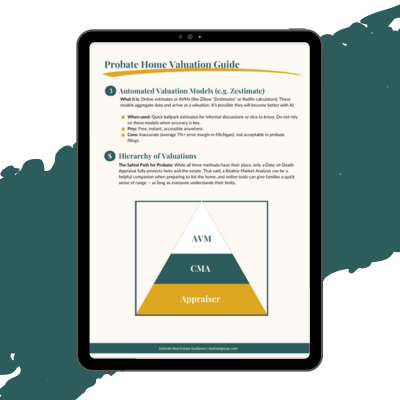
Not Sure What Your Probate Home Is Worth?
Read our free 3 home valuation guide that explores the three different valuations methods and which ones hold up in court, with the IRS, or selling the property.
A certified appraisal in Michigan usually costs $400–$600, and specialty appraisals (antiques, jewelry, business interests) can be higher.
🧭 Guiding Note: Families often use both. A PSA market analysis helps with early planning and listing decisions, while a licensed appraisal ensures compliance with tax requirements and provides legal protection if disputes arise.
Miscellaneous Costs
While going through probate, there are several miscellaneous and controllable costs for the estate. Some other expenses the estate may experience include:
- Bond Premiums: if required by the court
- Accountant or tax preparation: Usually needed to close the estate. Costs can vary depending on use of CPA or enrolled agent
- Junk removal services: Clear out a home can cost $500 to $5,000 depending on the volume of items and material involved. (check out best junk removal in Lansing)
- Estate Sale Services: Often charge a percentage of the sale proceeds. This can be a great way to bring money into the estate and keep belongings out of landfills.
- Publication expenses: A method of notifying creditors and the public.
Property Carrying Costs
For many families, the biggest asset, and therefore expense, in the estate is associated with the home. First, there are the associated carrying costs the estate must pay until the home can be sold or the estate closed. These expenses do not go away when a loved one passes away.
The estate may be responsible for:
- Mortgage payments
- Utilities and Insurance
- Property Taxes
- Maintenance in the form of lawn care, snow removal, and repairs
It’s not unusual for these carrying costs to total $500–$1,500 per month depending on the property. These cost can add up depending on how long the probate process in Michigan takes. Five to twelve months is not uncommon.

See What Waiting Really Costs
Carrying costs can eat away at the estate. Use the burn rate to see what holding the home costs.
When families live near the home in the estate, they can usually trade time for money. On the other hand, those who are trying to manage an estate while living out of state, may experience higher carrying costs.
Proper maintenance and ongoing care is one of the biggest costs that lowers the value of an estate.
Real Estate Fees
Second, an estate may see real estate commissions and selling fees if the property must be sold or the personal representative has decided to sell the property.
When it comes to selling a home, there are some direct and indirect fees to be aware of:
- Real estate commissions: Standard real estate commissions in Michigan are 5-6% of a home’s sale price, a probate-focused real estate agent may charge closer to 7%.
- Time on market: Your agent choice can influence how long the property sits on the market. The longer days on market, the higher the overall carrying costs.
- Process efficiency: Coordinating with attorneys, courts, and heirs reduces missteps — which, if left unchecked, can cost the estate.
- Vendor access: From junk removal to estate sales and cleaning crews, having established partners can secure quicker, sometimes discounted service.
When it comes to commissions, it is easy to focus on the percentage alone. But in probate, the real focus should be on value.
A higher commission can sometimes lower the estate’s total expenses when you account for time on market, access to trusted vendors, avoiding delays and failed closings.
The higher percentage commission for a probate-specialized real estate agent can often cost the estate less. Consider the value each agent brings rather than their cost.
Want the complete guide to selling a probate property in Michigan? We wrote it.
Who Pays For Probate?
In concept, the estate itself is meant to pay the costs of probate — not the personal representative or heirs. In cases where an estate has liquid assets, such as cash or stock accounts, this may not be an issue.
However, since real estate is the largest asset of many estates, a large portion of estates tends to have their cash tied up in the equity of their home. As a result, there is no money or cash to pay ongoing maintenance fees, property taxes, or the mortgage.
Leaving families wondering how they can financially keep the estate afloat.
What If the Estate Has No Cash to Pay Costs?
When there is insufficient cash, there are really four options families can use to pay for probate costs:
Costs are Advanced and Reimbursed: Sometimes family members or the personal representative pays upfront and is later reimbursed from the estate. It is important to keep accurate receipts and documentation if you plan to do this.
This can be a practical solution, but there is an important caution:
- Reimbursement only works if the estate ultimately has enough value left after debts and creditor claims.
- If the estate is insolvent (debts exceed assets), you may not be paid back.
- Check with the attorney or court to ensure your expenses qualify for reimbursement.
Assets Are Sold: Real estate, vehicles, or valuables can be sold to generate the needed funds. This is often necessary for larger estates and ensures costs are paid from the estate itself, not from heirs’ personal finances.
Deferred Payment: Some expenses, like real estate commissions, only need to be paid at the time of closing or receiving money. If you can, try to defer payment towards the end of probate when the estate may have more cash from selling assets. Negotiate with vendors so that necessary services (like cleanouts or appraisals) are paid at closing rather than upfront.
Cash Is Borrowed (not recommended): In some cases, families turn to credit cards, home equity loans, or probate cash advances to cover immediate costs. While this may seem like a quick solution, it can create long-term financial strain, interest payments, and unnecessary stress. The debt shifts the burden from the estate to the family — and can easily leave you worse off than when you started.
🧭 Guiding note: If you find yourself considering debt, pause and explore alternatives first. Selling assets or advancing cash with clear reimbursement protects both your finances and your family’s legacy without adding another layer of stress.
This scenario often feels overwhelming, but it’s more common than people realize. The key is clear planning and professional coordination so costs don’t fall unfairly on family members.
Reduce Michigan Probate Costs
The right strategies and team can make a significant difference and reduce the overall costs of probate in Michigan. Here are a few strategies to save time, money and stress.
Clear Communication: Communicating clearly with all parties and heirs can reduce the overall costs. Miscommunications and disputes tend to bring extra billable attorney fees. Clear roadmaps and plans keep everyone aligned.
Begin Early, Act With Purpose: Each month of delay in probate adds carrying costs — mortgage, taxes, insurance, upkeep. Moving forward promptly, while staying careful and methodical, can save the estate significant money.
Weigh All Options With Care: Carrying costs build month by month. Depending on the home’s condition, it may make sense to sell the house as-is for cash rather than pursuing a traditional listing. The key is to focus on the estate’s net outcome — what’s left after repairs, fees, and ongoing costs — not just the headline sales price.
Look at the full picture of costs, not just fees: Paying a realtor 7% instead of 6% may feel higher, but if that results in shaving three months off the sale timeline, the estate could save thousands in mortgage, utilities, and upkeep. A probate-focused realtor understands how to streamline the sale while still protecting value.
What It Adds Up To
For a simple estate with no disputes, costs may be contained to $3,000–$5,000 total.
For a complex estate with property, debts, or disagreements, total expenses can easily exceed $10,000–$15,000 — and sometimes more.
Probate doesn’t have to feel like a blank check. When you know what to expect — and when you have a guide who knows how to protect your time, money, and peace of mind — you can move through probate with clarity and confidence.
At Dolinski, our role is to help Michigan families navigate the real estate side of probate with compassion over commission and clarity over chaos. If you’re in this process now, explore our Michigan Probate Resource Hub.