
When a loved one passes away, families often wonder, “How long will probate take?”
The honest answer: it depends.
Probate in Michigan can last anywhere from five months for simple estates to a year or more for complex estates. While court requirements, family disputes, and personal circumstances all influence the timeline, the biggest factor is usually the family home.
In most cases, the property becomes the pivot point that drives everything else — from creditor claims to court involvement to disagreements among heirs. Even issues that seem separate, like delays in paperwork or disputes over fairness, often trace back to decisions about the home.
Whether the home needs to be sold to pay debts, divided among heirs, or simply maintained while probate unfolds — real estate usually determines how long the process lasts.
Important note: the timelines provided for probate are based on the date probate is officially opened with the prospective court system in Michigan rather than the date of death.
This article guides you through:
- A typical probate timelines
- Key steps in the process to recognize where delays occur
- Common reasons for delays (and how to prevent them)
- Tips for moving through the process efficiently with more confidence and less stress
Typical Probate Timeline In Michigan
Keep in mind these general guidelines shared are meant to help create clarity. Every estate is unique, and circumstances can shorten or extend the process in ways no article or chart can predict. In practice, there is no such thing as a truly “typical” or “average” estate — each one follows its own path.
Simple Estates (5-7 months): Few assets, no disputes among heirs, and no home sale required (or the home passes directly to an heir outside probate). May fall under simplified estate or informal probate.
Average Estates (8-12 months): Where most families find themselves. There is a family home that needs to be sold, multiple creditors or heirs involved, and may need court-approval. May fall under informal or formal probate process.
Complex Estates (12+ months): Disagreements about whether to sell, rent or hold the family home, the home is in despair or has existing liens, and large debts, tax complications, or businesses tied to the estate.
Probate Timeline Calculator
Key Steps In The Probate Process
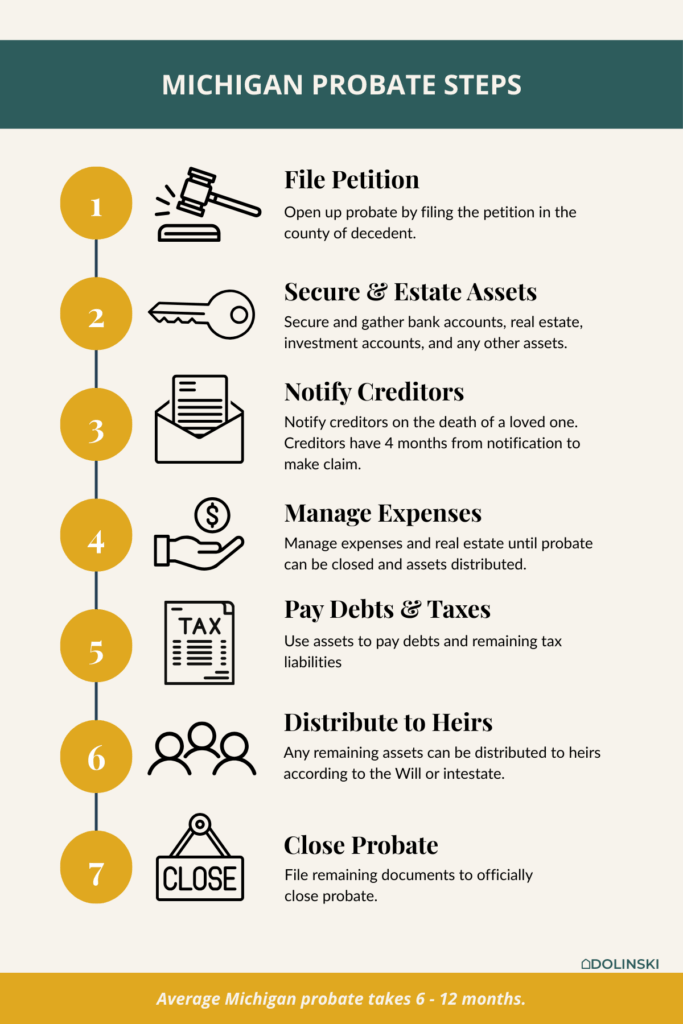
Step 1 – Open Up Probate: Opening probate starts with filing the required documents and petition with the county-courts where the deceased lived. So, if you live in Grand Rapids, but your loved one lived in Lansing, you will most likely need to file a petition with Ingham County. Learn jargon-free key probate terms in Michigan so this doesn’t feel like you’re drowning in legal jargon.
Step 2 – A Personal Representative (or Executor) is Appointed: The personal representative is the person responsible for handling the affairs of the estate. They will have the authority to hire professionals (like attorneys or real estate agents) and be responsible for securing the estate’s assets, like the home. An executor can be appointed from a Will or through state laws.
Watch the full-length interview where I sit down with Nick Leydorf to discuss Probate Basics:
Step 3 – Notifying Heirs and Creditors: “It surprises people to learn, but probate is mostly set up to protect creditors”, according to Leydorf. Whether reverse mortgage companies, credit cards, or medical bills, creditors need to be notified and have four-months to file claims. Generally, these creditor claims are paid from any assets in the estate.
Step 4 – Inventory and Valuation of Assets: All assets in the estate must be assigned a value. Bank accounts and stock accounts are relatively straight-forward: it’s the cash value.
The family home is more difficult. Depending on the circumstance, the court may require a formal, accurate valuation of the home. Online estimates like Zillow’s Zestimate — or even a casual price opinion from a typical agent — rarely meet that standard. Relying on them can slow down the probate process or even cause disputes. For probate, precision matters.
In these cases, you will want a valuation from a professional such as an appraiser or Pricing Strategy Advisor (PSA) real estate agent. Which one will suffice depends on how much involvement there is with the court during your probate process.
Step 5 – Paying Debts and Taxes: Once assets have been determined and debts calculated, the estate stands due against what is owed. It must pay what it owes from what it owns. Each estate will need to create a financial plan for how to settle the debts and taxes. In many cases, the home must be sold to pay these obligations.
📊 Estate Snapshot: Debt can play a substantial factor in an estate — averaging around $61,500 at the time of death — the home may need to be sold to settle these debts. In Michigan, estate valued between $50,000 and $250,000, the family home represents 40 to 70% of the net worth. Cash and liquid-assets are often a smaller portion of the estate. Since most wealth is tied up in the home—not cash—selling or valuing the property accurately is often the single most important step in keeping probate on track.
Step 6 – Distribute Remaining Assets: Once the debts are settled and taxes paid, the court will allow the remaining assets to be distributed to heirs. In some cases, this may be the home. In other cases, it may be the proceeds from a home sale.
What Causes Delays In Probate?
Having done this for a time, I can say probate delays come from a few predictable places.
Family Disputes: Arguments about the Will, who will be the personal representative, whether the personal representative is acting fairly can create delays. These disagreements may require court involvement, can delay the process, and cost the estate in a way that reduces the distributable assets. Disagreements about whether to sell the house, how much it’s worth, or who should get it can stall probate for months.
Missing or Unclear Documents: A lost will, outdated deed or missing financial records. A lost Will opens up disagreement and determining who to name as the personal representative, outdated deeds or missing title can cause delays in being able to sell the home, and missing financial records will create problems in verifying the veracity of creditor claims.
Homes in Poor Condition: Vacant homes can attract city fines, insurance lapses, or costly damage (frozen pipes, roof leaks). These issues must be resolved before selling.
Complex Assets Needing Sold:Business, rental properties or homes that need major repairs before being sold can cause delays. In addition, the general real estate market could extend this. In good times, the market will not cause much delay. During a buyer’s market or recession, the home may sit on the market for a time.
Court Scheduling Backlogs: Courts can only move as fast as their calendars allow — and probate cases often wait behind other legal matters. This was a big problem during the Covid-pandemic and specific counties saw more backlogs and delays than other counties in Michigan.
How Families Can Prevent Delays
Here’s how to keep the process moving — especially when real estate is involved:
- File quickly. Start the probate petition as soon as possible.
- Get professional valuations. Appraisers or Pricing Strategy Advisors can prevent disputes over home values.
- Keep paperwork organized. Deeds, wills, tax documents, and insurance should be gathered early.
- Maintain the property. Avoid city fines, insurance lapses, or costly damage while waiting to sell.
- Work with experienced professionals. Attorneys and real estate agents who know probate can anticipate issues before they become delays.
Most families know to hire a Michigan attorney or CPA during probate because of the legal, tax, and financial complexity. But when it comes to selling the home, many fall into the “I’ll just hire my friend who’s a realtor” mindset.
That choice can backfire. Probate properties have unique requirements:
- Court approvals and filings
- Strict timelines for creditor notices
- Documentation of fair market value that can stand up in court
- Navigating repairs, insurance, and property maintenance while the estate is in limbo.
A well-intentioned but inexperienced probate realtor can miss these steps — causing delays, legal challenges, or even disputes among heirs.
What To Look For In A Probate-Savvy Real Estate Agent
A probate-savvy real estate agent ensures the home is valued, marketed, and sold correctly under court requirements. In addition, they see their value beyond the transaction and can provide real value to families.
They help:
- Connect you to trusted-vendors for exclusive discounts such as junk removal, handymen, and more.
- Guide you through the title requirements, proof of authority, and unique disclosure requirements.
- Prevent costly mistakes in pricing, over-repairs, and timing
- Balance the speed of sale with maximizing value for heirs.
Final Thoughts: Why The Home Deserves Special Care
Probate can feel slow and overwhelming, but knowing what to expect — and understanding the role of real estate — makes it manageable.
Remember:
- Simple estates without a home sale may close in 5–7 months.
- Most estates with a home take closer to a year.
- Complex estates with disputes, liens, or property issues can take much longer.
Because the family home is often the largest and most emotional part of the estate, it deserves expert attention. At Dolinski, we specialize in helping families:
- Value inherited homes for court and tax purposes.
- Maintain and protect vacant properties during probate.
- Sell homes in probate — whether as-is, investor-ready, or fully listed on the open market.
👉 Our role is to ease the burden, keep the timeline on track, and make sure families can move forward with clarity and confidence.
Probate may never feel “fast,” but it doesn’t have to feel overwhelming. Understanding the steps and knowing what causes delays gives families peace of mind during a difficult season.
For more clarity and guidance on Michigan probate and real estate, check out our probate resource hub.