
Selling a parent’s home is rarely just a real estate decision.
For most families, it happens during a time of change. Sometimes the change is gradual. And others, it’s sudden.
The process of selling the home can be tied to aging, declining health, caregiving, a legal-process (often probate), part of an inheritance process, or unresolved family questions that can stretch on for years.
This is not a shortcut guide. It is a clarity guide. Throughout the guide, you can dive deeper into our specific-situations guides for more “how-to” type content.
If you’re looking for immediate steps, you can jump directly to the section that matches your situation. This guide starts by explaining why the process is confusing before showing how to move forward.
What People Mean When They Say Selling A Parent’s Home
When people search for advice on selling a parent’s house, they’re often talking about very different situations, but presented with single, similar solutions.
There are many reasons someone may be searching “sell my parent’s home”. Some common reasons include:
- A parent who is still alive, but can no longer live safely at home
- A parent has passed away and the home is tied up in probate
- The home has passed various legal-hurdles and been inherited
- Years have passed, the house was lived in, rented, or ignored, but people still call it their parent’s home
- Someone just wants to be “done” but doesn’t know what that means anymore
All of these situations fall under what we call an estate transition. Often what ties these situations together is the responsibility and emotion involved.
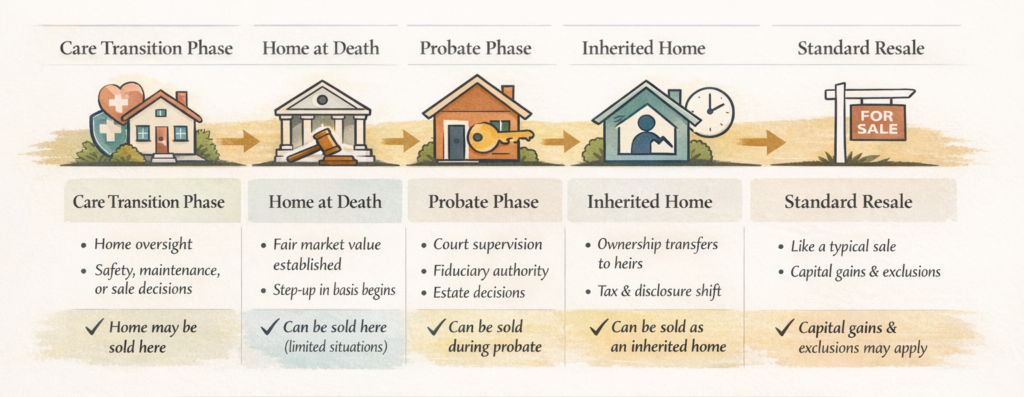
While caring for a loved one or after the death of a loved one, real estate decisions are usually within the constraints of the legal process and frameworks, such as conservatorships, power of attorneys, or probate.
In these cases, there is often a fiduciary duty created. Meaning, someone — often a child — is acting in the best interest of another person or an estate. This creates responsibility, liability, and risk.
As a home progresses through the legal system, eventually property may be transferred to heirs and beneficiaries. At this point, property becomes “inherited”.
The legal structure may fall away, but the emotional elements remain. Decisions are no longer constrained by courts, yet they are deeply shaped by memory, family dynamics, grief, and the question of what honoring this home really means.
This is the boundary of our work at Dolinski. We focus on the process and needs that sit at the intersection of fiduciary obligation, emotional weight, and legacy. Not simply transactions. Nor limited to age-based situations.
What Is An Estate Transition
Selling a home is only a single part of an estate transition. In fact, in some cases, selling the home may never be required. However, a home usually needs to be dealt with.
It’s not a single event. Everyone’s transition looks different.
For some, it is a slow, cumulative work that unfolds across years, often in phases, as care needs change, authority shifts and decisions move from estate planning to estate management and execution.
For others, it’s a sudden, overwhelming drowning-like process that occurs after death.
An estate transition may include tasks such as:
-
- Caregiving and safety decisions
- Managing bills, accounts and property on behalf of another person
- Deciding whether a home should be sold to fund care or reduce risk
- The entire process of settling the affairs of an estate
- Handling tax basis, deferred maintenance, or long-delayed decisions
- Resolving shared ownership or family dynamics
- Valuing a home during an estate transition
What makes this a transition is not the task itself, but the shift in responsibility — from one person to another, or from life to legacy.
Throughout these phases, people are always asking themselves if they should sell now or wait.
Who Can Help: Home Transition Advisors
In every estate transition, there are different professionals who can help.
Home Transition Advisors are professionals who help families navigate decisions across an estate transition — whether during care, probate, or after inheritance — each within their specific area of expertise.
Examples include:
- Attorneys
- CPAs or Enrolled Agents
- Care managers
- Financial and Insurance Advisors
- Real Estate Professionals
Together, these Home Transition Advisors help families make decisions across legal, financial, and practical domains. No single professional replaces the others.
Home Transition Advisors are professionals who understand how a complex transition unfolds over time within their specific domain.
Rather than focusing on isolated tasks or single moments, Home Transition Advisors recognize that estate-related decisions are interconnected — shaped by changing authority, evolving responsibilities, family dynamics, and long-term consequences.
Within their area of expertise, Home Transition Advisors:
- Understand the full estate transition, not just one phase of it
- Work across care transitions, probate, inheritance, and delayed resolution, rather than treating each as a separate event
- Apply domain knowledge with awareness of downstream implications, risks, and tradeoffs
- Coordinate decisions within a broader system, alongside legal, financial, and family realities
- Focus on continuity and judgment, not just task completion
- Utilize the Home Transition Framework.
This is what separates estate-focused professionals from transactional ones.
Finding A Home Transition Advisor (and why this is confusing)
Finding qualified professionals during an estate transition is harder than it should be—not because expertise is rare, but because the market is fragmented and inconsistently labeled.
In some fields, professional roles are clearly defined. Attorneys, for example, often work under established practice areas such as estate planning, elder law, or probate. While those labels don’t guarantee quality, they at least signal a shared body of work.
In other fields, clarity breaks down.
In accounting, there is no widely recognized category for professionals who regularly handle estate-related complexity. Many CPAs and enrolled agents are capable, but there is little language to distinguish those who work across estate transitions from those who only encounter them occasionally.
Real estate sits somewhere in the middle.
That problem-based searching is a reflection of how estate transitions actually work. Real estate decisions arise at different moments of an estate transition.
Because of this, real estate professionals involved in estate transitions are often described using situational labels, such as:
- Probate realtor: when a home is sold during court-supervised probate
- Inherited home specialist: when ownership has already transferred
- Senior or care-transition agent: when decisions are tied to aging, safety, or care needs
- Standard real estate agent: when an inherited home has been held for years and now looks like a typical sale
These labels can be helpful as shorthand, but they are not defining. They describe when someone may be involved. Not whether they understand the broader transition or the downstream implications of decisions made along the way.
What matters more than the title is whether the real estate professional understands:
- how authority and ownership shift over time
- how early decisions affect later options
- how real estate fits alongside legal, financial, and family realities
- how to guide decisions when timing, risk, and emotions overlap
Our role fits within that problem-based reality.
Dolinski Advisory exists to advance the Home Transition profession and give a clear language to consumers by developing educational resources, research, and the Home Transition Framework™. Home Transition Advisors use that framework to help families navigate the legal, financial, caregiving, and real estate decisions surrounding a home transition.
If you’re navigating an estate transition, we wrote an article on what to look for in a real estate agent.
Selling A Parent’s Home As Part of Care Transitions
This state often begins quietly or all at once.
Sometimes responsibility shifts slowly, as a parent’s health or cognitive ability declines over time. Other times it happens overnight, triggered by a stroke, fall, hospitalization, or sudden move into care.
In either case, families are often making decisions before the situation fully settles.
What makes this state difficult isn’t just uncertainty. It’s the responsibility without clarity.
Families may be caring for a home while holding out hope a parent might return, unsure how permanent the situation really is.
Real estate decisions during care transitions are rarely about market timing. They are about safety, sustainability, and acting in someone else’s best interest while circumstances are still unfolding.
Common experiences include:
- Managing a home while care needs increase
- Uncertainty about whether the home will be needed again
- Balancing caregiving with financial strain
- Trying to avoid “doing something irreversible” too early
- Feeling pressure to make decisions without clear authority
For many people, this is when phrases like “selling my parent’s home” first appear, even though selling is only one possible outcome.
During care transitions, real estate is often part of a larger planning conversation.
Families may be thinking about aging in place, selling to pay for long-term care, Medicaid or Medicare considerations, or whether current arrangements are financially sustainable.
Selling the home is one option to pay for long-term care, but not the starting point.
Other possibilities may include keeping the home temporarily, renting it, selling to a family member, or maintaining it while care stabilizes.
What often determines what’s possible is authority.
Depending on a parent’s capacity, decisions may require:
- The parent’s direct involvement
- A power of attorney
- Guardianship or conservatorship
- Prior estate planning that already established authority
How authority is established affects not just whether a home can be sold, but how defensible those decisions are later.
When selling does become appropriate, “maximization” usually means something different than in a typical sale. It’s less about extracting the highest price and more about doing what is best for the parent—financially, emotionally, and practically.
That often leads to:
- Selling the home as-is
- Coordinating belongings and clean-out
- Prioritizing clarity and defensibility over perfection
Like probate, care-related sales are often described with situational labels, but the underlying work is the same: making responsible real estate decisions during a moment of transition.
Care transitions are not a precursor to probate. They are one of several contexts where real estate decisions may arise within an estate transition.
Sell A Parent’s Home In Probate
This stage tends to feel more formal and more intimidating.
After a death, responsibility often shifts into a defined legal process. There may be court oversight, deadlines, and heightened accountability. Even when emotions are still raw, decisions are expected to move forward.
What makes this stage difficult isn’t just the process — it’s the weight of acting on behalf of an estate, knowing decisions may later be reviewed or questioned. Executors have a significant weight of duty.
Common experiences include:
- Feeling responsible to “do everything correctly”
- Uncertainty about timing, value, or approval requirements
- Tension between speed and defensibility
Trying to make clear decisions while still grieving
For many people, this is where the term “probate sale” enters the conversation, even though what they’re really navigating is responsibility, not a transaction.
If a parent passes away and the home is still in their name, the property may need to pass through probate before it can be sold.
Probate is the court-supervised process of:
- Validating authority to act
- Identifying heirs
- Paying debts
- Transferring or selling property
Not all homes require probate, but when they do, the sale process changes.
Common probate-specific considerations:
- Court authority to sell
- Executor or personal representative responsibilities
- Home Valuation and defensibility
- Timelines that don’t match market speed
Selling during probate is often described with labels like probate sale or probate realtor, but these labels describe when the sale occurs and not the nature of the work itself.
Probate is simply one phase within a larger estate transition.
Selling a Home After It’s Inherited
Once a home has transferred to heirs, the court structure often falls away, but the difficulty doesn’t.
This stage is often assumed to be simple because the legal process is over. In reality, it’s where decisions are easiest to delay and hardest to resolve.
Inherited homes frequently involve shared ownership, uneven emotional attachment, or differing financial needs. Without deadlines, families can find themselves stuck.
Common situations include:
- Siblings disagreeing on whether to sell or keep the home
- One person living in or maintaining the property while others wait
- Conversations about buyouts that feel personal rather than practical
- Letting time pass because no option feels “right”
This stage often carries more emotional weight than legal complexity.
That’s what makes it challenging. This stage shares several commonalities with a traditional real estate sale. However, there are often significantly more family dynamics involved.
If you’re in this stage, you may want deeper guidance specific to this moment. We’ve created separate resources that go further into the considerations that tend to matter most when selling an inherited home.
Selling a Parent’s Home Years Later
When a parent’s home is sold years after inheritance, the process is usually very similar to a standard real estate sale.
At this point, probate is long finished and ownership is clear. Selling typically involves the same basic steps as any other sale: choosing an agent, preparing the property, listing it, and closing.
What can differ are the implications, not the mechanics.
The home may have been lived in, rented, or held without a clear plan. Those choices can affect taxes, disclosures, or how the sale is structured, but they don’t change the fundamental process.
This is not a failure of planning. It’s a common way estate transitions unfold. Life moves forward, and property decisions often follow on a different timeline.
For example, the sale itself may look routine, but prior use of the property can matter.
A home that was rented to a tenant, land that was leased to a farmer, acreage kept as hunting land, or a property that sat vacant for years can each carry different tax, disclosure, or timing considerations.
In some cases, the property may no longer qualify for certain exclusions, or prior agreements may need to be resolved before closing.
None of this changes how the home is sold, it changes what needs to be accounted for before and during the sale.
Many mistakes families make when selling a parent’s home aren’t about effort. They’re about acting before the situation is fully understood. This video highlights common pitfalls in selling a parent’s home.
Conclusion
Selling a parent’s home is rarely just a real estate task. It’s one decision inside a much larger transition — one shaped by responsibility, authority, timing, and the realities of family and care.
Across this guide, we’ve shown that “selling a parent’s home” can mean very different things depending on context. It may arise during a care transition, under court-supervised probate, shortly after inheritance, or years later when circumstances finally change.
Each situation carries its own constraints, risks, and considerations—even when the sale itself looks familiar on the surface.
That’s why good guidance isn’t about rushing toward a checklist.
It’s about understanding where the property fits within the broader estate transition—and making decisions that align with that reality.
Alignment matters between:
- Legal authority: who has the right to act
- Financial reality: what is sustainable over time
- Family readiness: what people are emotionally and practically prepared for
- Market conditions: what options exist right now
- Timing: when clarity is better than speed
Selling a parent’s home doesn’t need to be fast to be effective. It needs to be defensible, appropriate, and grounded in context.
Our role is to help families see that context clearly, so real estate decisions support the transition as a whole, rather than becoming another source of stress inside it.
If you’re navigating a situation that doesn’t neatly fit a label, you’re not alone. That’s how estate transitions actually work.